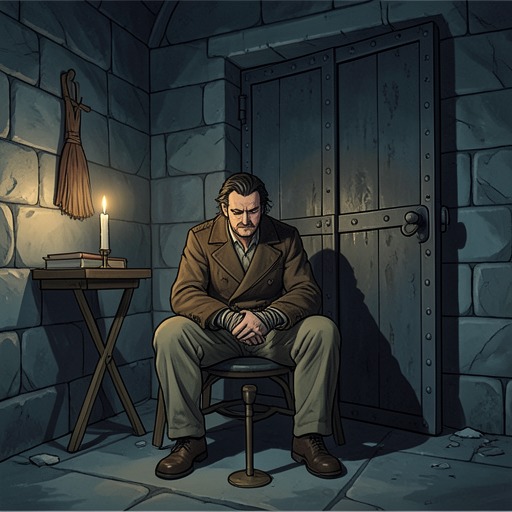
Goldmund's Attempted Escape from the Dungeon
Narcissus and GoldmundGoldmund's Attempted Escape from the Dungeon is the crisis in which Goldmund, awaiting execution after the Count condemns him for theft, refuses to accept death and makes a plan to escape. He frees his hands in the night and prepares to seize an opportunity when the priest arrives, but Narcissus's political intervention changes the outcome: Goldmund is pardoned and taken away from the city. The episode turns a condemned prisoner's struggle for immediate survival into the occasion for his reunion with his old friend.
Causes and Imprisonment
The Count discovers Goldmund in the castle and dismisses his claim to be a homeless man seeking mercy. He asks whether Goldmund molested the lady, then decides that the theft charge is enough to condemn him. Goldmund is bound and ordered into the dungeon, with execution set for the following morning. The accusation conceals the circumstances Goldmund later explains to Narcissus: he had gone to meet the Count's mistress, though the scene made him appear to be stealing.
As guards escort him through the castle, Goldmund sees only the torch held close to him and experiences the prospect of death as an abyss. Two visiting priests learn that he has been condemned without a confessor. One asserts that even a thief retains the right to confession and the sacraments, and requires the guards to promise that Goldmund will not be taken away before he can attend to him. The cleric's intervention offers a brief procedural safeguard, but Goldmund does not yet know whether it can alter his sentence.
The Escape Plan
In the cellar, Goldmund's immediate aim is not spiritual reassurance but continued life. He has lost certainty about God, judgment, and an afterlife, and wants the vulnerable, temporary life he knows. He therefore treats the promised priest as a possible means of escape: first he will try to win the man's help, persuade him to speak on his behalf, or secure a delay. If that fails, he resolves to use a stool to kill the priest, take his robes, and flee. He also imagines seeking refuge with Marie.
Goldmund acts on the plan before dawn. Despite the pain in his bound wrists, he works the ropes with his teeth, then searches the cellar wall and finds the stone steps over which he had stumbled. He rubs the rope against a stone edge until it parts. By the time gray light appears beneath the door, his hands are free, though swollen and stiff. He hides the change by crouching at the table with his hands between his knees, ready to pretend that he remains bound.
His preparations grow more violent as he anticipates resistance. If the priest will not help and is left alone with him, Goldmund intends to kill him with a stool, change into his robes, and get beyond the castle. If necessary, he is prepared to attack the guards too. He counts on his eyes, accustomed to the cellar's darkness, giving him an advantage over men entering from outside. At the same time, he hopes Agnes might intervene, perhaps with help from her chambermaid Berta or a trusted groom. The plan is a set of contingencies, not a completed escape: Goldmund waits for the priest and watches the light under the door, determined to act before his strength and resolve ebb.
Pardon and Aftermath
The escape attempt is interrupted by Narcissus, now Abbot, who comes to tell Goldmund that he has been pardoned and to take him away. Goldmund initially maintains a brittle, casual manner, pointing out that he is still a vagrant and has been sentenced to hang. Narcissus understands the pride behind the pose and answers that the pardon has already been secured. Their handshake, held for a long time, gives way to playful conversation as they prepare to leave together for Mariabronn.
Narcissus's rescue is connected to political negotiation, not simply an independent act of clemency. He explains that he had been sent as a delegate to negotiate with the Count, a favorite of the Emperor, on matters between the Emperor and the religious order; the negotiations had achieved little. Goldmund does not know that Narcissus secured his life by making concessions to the Count. When Goldmund admits that his meeting with the Count's mistress explains why he was in the castle, Narcissus remarks that the Count was willing to bargain. Thus the theft sentence and its reversal expose how Goldmund's survival depends both on a clerical right to religious care and on a political exchange.
Significance
The episode makes the threat of execution concrete while showing Goldmund's refusal to surrender his will to live. His first response to mortal danger is practical improvisation: he loosens the ropes, studies the cellar, and weighs whom he might persuade or overpower. Yet the escape does not come through the violence he prepares. Narcissus arrives with a pardon, and their renewed friendship redirects the plot from solitary flight toward return and companionship. Goldmund's struggle for life is resolved through a relationship that had begun at Mariabronn and now intervenes in the world beyond the cloister.